|
THE
VICTORIA
FALLS
map
Described by the Kololo tribe living in the area in
the 1800s as Mosi-oa-Tunya - the Smoke that Thunders and in
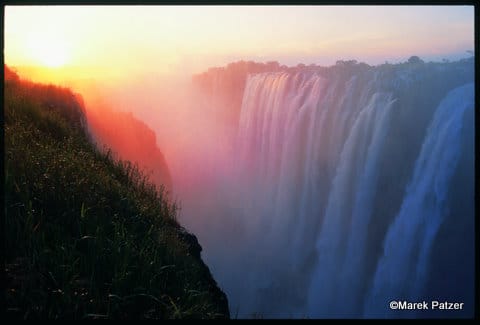
more modern terms as the greatest known curtain of falling water, Victoria
Falls are a spectacular sight of awe-inspiring beauty and grandeur on the Zambezi River,
bordering Zambia and Zimbabwe.
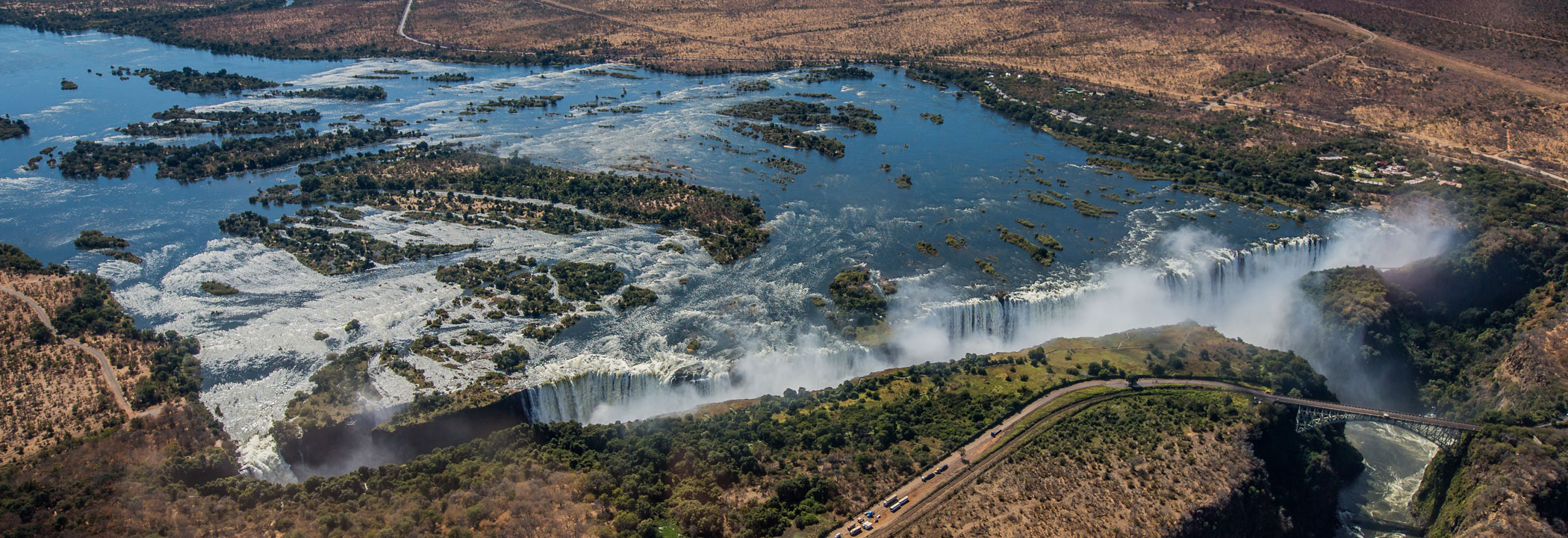
Columns of spray can be seen
from miles away as 546 million cubic meters of water per minute plummet over the edge (at
the height of the flood season) over a width of nearly two kilometers into a
deep gorge over 100 meters below. The wide basalt cliff, over which the
falls thunder, transforms the Zambezi
from a wide placid river to a ferocious torrent cutting through a series of
dramatic gorges.
Facing
the Falls is another sheer wall of basalt, rising to the same height and
capped by mist-soaked rain forest. A path along the edge of the forest
provides the visitor who is prepared to brave the tremendous spray with an
unparalleled series of views of the Falls.
One special vantage
point is across the Knife edge bridge, where visitors can have the finest view of the
Eastern Cataract and the Main Falls as well as the Boiling Pot where the river turns and
heads down the Batoka Gorge. Other vantage points include the Falls bridge and the Lookout
Tree which commands a panoramic view across the Main Falls.
"The first impression was unmistakable;
immense power, the raw energy unleashed when the entire Zambezi leaps wildly into a black
two kilometer wide abyss. The scale is massive, the spectacle spellbinding and perpetually
changing. The falls hiss and roar as if possessed, they rumble and crash like thunder.
Vast clouds spew and billow out from the seething cauldron of its dark impenetrable
depths. The moving water creates a magnetism that sucks you closer, so that you recoil in
horror to quench a subliminal sacrificial urge." (Jumbo Williams, Zambezi, River
of Africa. 1988)

Sightseeing
The Victoria Falls Bridge was
commissioned by Cecil John Rhodes in 1900, although he never visited the falls and died
before construction began, he expressed his wish that the "railway should cross the
Zambezi just below the Victoria Falls. I should like to have the spray of the falls over
the carriages."
The bridge affords a magnificent
view both down the gorge on the one side and through to the falls on the
other. The immense depth of the gorge can be fully appreciated from this
perspective and combined with the sea green river below, the shiny black
rock face
and lush green foliage, the 360 degree view from the bridge is breathtaking.
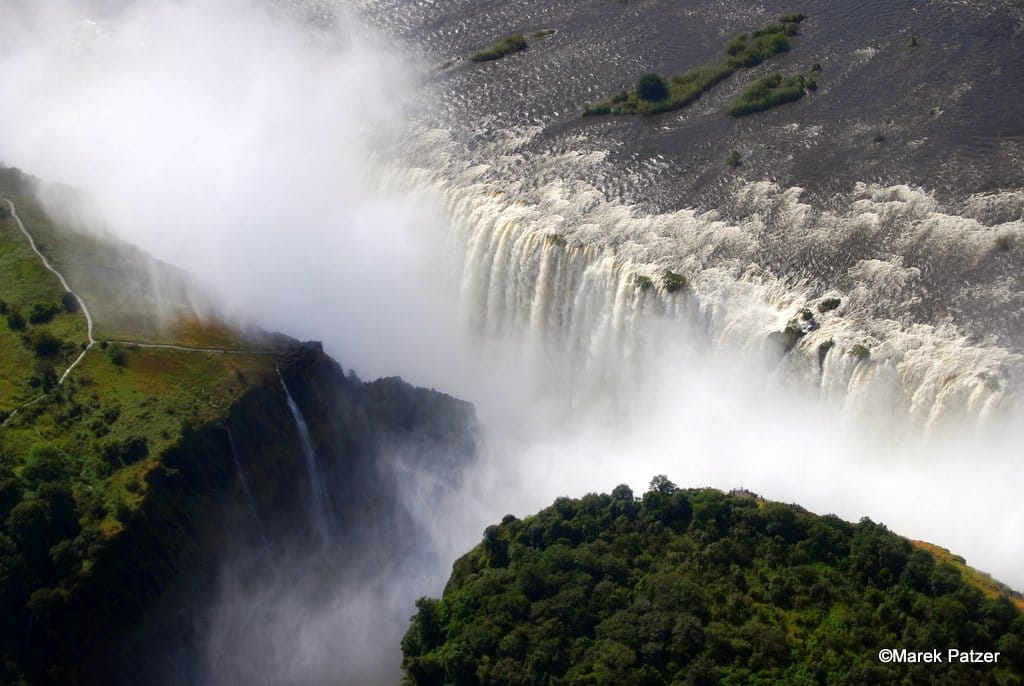
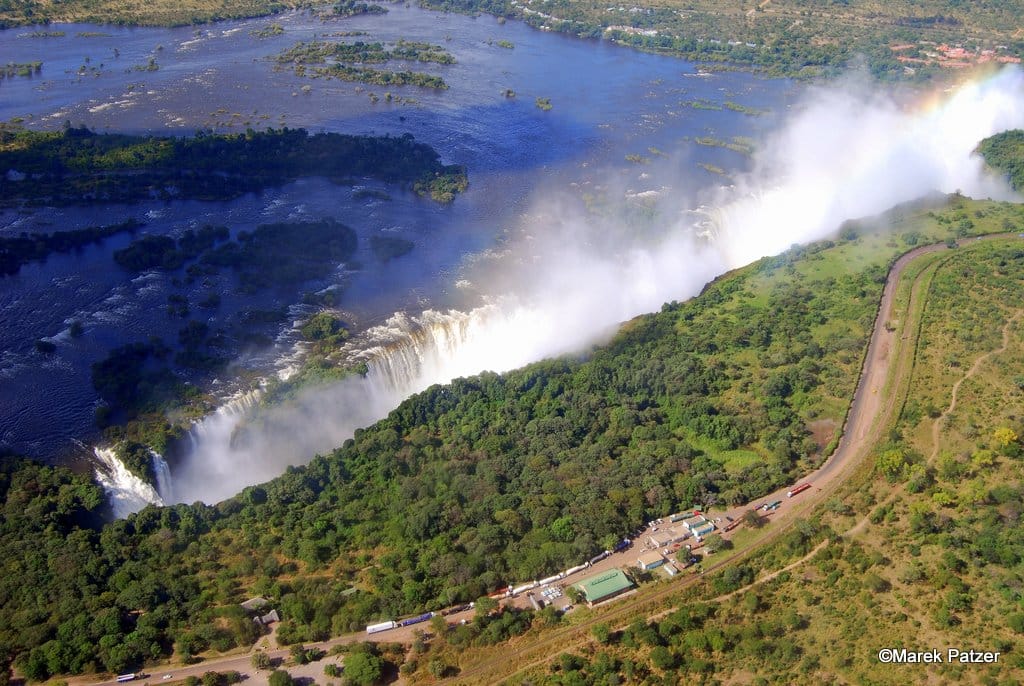
Aerial view of the Falls:
To fully appreciate the incredible size of the Falls, and the awesome power of the water
as it carves into the deep zig zagging gorges for eight kilometres, one must see it from
the air. Micro-light and fixed wing flights are available. The pilot will take you along
the wide tranquil upper Zambezi, and over the huge 2 km rent in the earth. The
breathtaking sight of this magnificent natural phenomena, seen in all its glory from the
air, is unforgettable. Helicopter Flights are also available from
United Air Charters.
Walks
On the opposite cliff, facing the falls, you can take a well marked and paved walk through
the rain forests. Every so often the path will open out into a clearing for a view
of the
falls. Further along this path is the Knife Edge Bridge which affords an
impressive panorama depending on the time of year. Although less can be seen of the width
of the Falls during the wet season, the intense spray provides welcome
relief from the
heat, but dont carry anything you dont want to get wet!
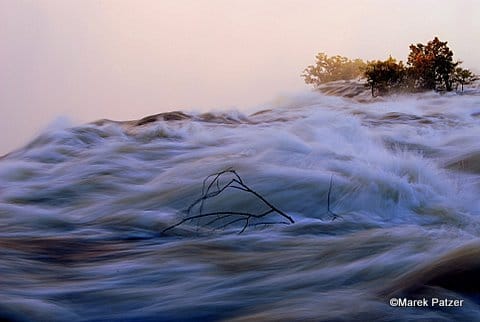
During the dry season, be sure to take a walk
along the lip of the Falls themselves. Sometimes the water is low enough to walk all the
way across to Livingstone Island, the place where David Livingstone had his first
glimpse of the Falls. This is surely one of the most magnificent views in the area.
Another interesting perspective is deep within
the gorge into which the Falls descend. From the parking lot, look for the signs pointing
to "The Boiling Pot." Its quite a steep climb, but well-worn steps
make it a fairly easy descent. Coming up is of course a little more strenuous, but the
view from below of the wide Zambezi thundering over the cliff, then compressed into the
deep thin crevice turning into the Batoka Gorge, crashing and swirling over rapids, is
quite spectacular. From this vantage point one can also see up to the impressive Victoria
Falls Bridge, spanning the gorge over 100 meters above.

The best place for a wide range of crafts and
curios is the Mukuni Victoria Falls Craft Village. From intricate animal carvings
in stone, wood, or the beautiful green malachite, masks, drums, marimbas, spoons, book
ends, walking sticks, jewellery and much more. The vendors can be really pushy however,
yelling for your attention from all sides, so be firm. Look at everything before buying as
some offer better quality than others. They are usually happy to trade for things like T
shirts, batteries, shoes, or anything else hard to come by in Zambia. Youll find it
in the parking area just above the Falls where most of the walks begin and alongside the Victoria
Falls Field Museum. This little museum attempts to explain how the falls were formed
over the millenia. It is built over an actual excavation site that has uncovered evidence
of early hominids who lived in the area as far back as 2.5 million years ago.
Mosi O Tunya National Park is situated
along the upper Zambezi stretching from and including the Falls for about 12kms up river.
It is only 66 square kilometers but provides a home for numerous antelope species, zebra,
giraffe and the recently acquired white rhinos, one of whom gave birth in the park in
1994. These are the only rhinos to be seen in Zambia as its previously large population
has been completely eliminated through poaching. One can take a pleasant drive around the
park in a couple of hours and almost all the species there should be seen at close range.
Since there are no predators, they are very relaxed and afford some excellent photo
opportunities.
Mukuni
Village is an authentic tribal village where thousands of people live and work. In
July of each year the Leya people partake in the colorful Lwiindi Ceremony. The local
people believe the spirits of their ancestors still dwell in the gorges of the Falls and
during the Lwiindi, they offer sacrifices to them for rain.
Getting
there
The Falls can be approached from the town of
Livingstone by traveling south on Mosi O Tunya road for some 11 kilometers. Just before
the border, there is a turning to the right which leads to a parking area. Walks all
around the Falls are accessible from this point. If approaching from Zimbabwe, cross the
border at the town of Victoria Falls and watch for the left turning just after the Zambian
customs post.
When
to go
Different times of the year will provide
completely different experiences of the Falls region. Peak flood season is around March
and April and the full power of the falls can be experienced in all its glory. But due to
the masses of spray rising from the fallen water the full width of the Falls cannot be
seen on foot. The aerial view at this time however is spectacular, with clouds of spray
rising high into the sky.
As the floods abate the view of the falls gets
better and better through the year, but at its lowest, around November and December
the Falls become little rivulets running over the edge and in some places along the 1,7km
width no water falls at all. This seasons gift is the view of the impressive cliffs
that form the Falls wall and the magnitude of the abyss can be fully appreciated. Sobek
and Safari Par Excellence do trips by raft to the base of the Falls in low season called
the float of angels".
Getting around
Hemingways - offers tours,
transfers and vehicle hire, as well as wheelchair accessible vehicles. AJ Car Hire and Tours offers chauffeur driven cars or
self drive hire and takes tours around the area as well as airport
transfers. Makoro
Quest also does day trips and transfers
Tours from
Livingstone
Try
Wildside Tours & Safaris
for a variety of trips in the region.
Nomad African Travel
have their Zambian base in Livingstone. They offer set guided tours and
tailor made tours both within Zambia and other countries in Southern
Africa.
Creation
of the Falls
It is thought that earth movement in an
earlier geological period diverted the south-easterly flowing upper Zambezi to a general
easterly direction and so initiated the development of a waterfall in an area occupied by
a massive bed of basalt which is about 305 m thick.
The
basalt, through which the Zambezi runs for 209 kms in the Livingstone area is
characterised by very marked joints or cracks, which may have developed as the molten lava
cooled. One dominant series of joints running in an east-west direction is associated with
zones of soft material within the basalt.
Since the Zambezi is flowing due south in the
Livingstone area, these softer materials are very easily eroded to form the great
east-west gorges. Upstream retreat of the Falls is due to a second major series of joints
running north-south. Gradual erosion of small joints that run north-south caused the river
to be concentrated into a narrow fissure and the broad fall line was abandoned. Once this
happened, it was only a question of time before the narrow gorges cut back into another
transverse fracture zone of soft material. This gouging out of the soft zone again
established a broad fall. This process has been repeated over many years and the zigzag
gorges represent seven previous lines of Falls.
The Devils Cataract, on the Zimbabwe
side, which is 21-37 m lower than the rest of the present falls, shows how the force of
water is starting to cut back along such a line of weakness. It will probably erode its
way back to another east-west joint where a future line of the falls will eventually
become established.
Livingstones first sighting
In 1851, Livingstone first heard of the great
waterfall, but it was only in 1855 that he set out to visit it. He spent the night on Kalai Island a few kilometers upstream of the Falls, having come down river by foot, and
the next morning set off in a small canoe to approach the thundering smoke. He landed on
the biggest island on the lip of the falls, now called Livingstone Island and from there
obtained his first view of the falls.
" Creeping with awe to the verge, I
peered down into a large rent which had been made from bank to bank of the broad Zambezi,
and saw that a stream of a thousand yards broad leaped down a hundred feet and then became
suddenly compressed into a space of fifteen to twenty yards....the most wonderful sight I
had witnessed in Africa."
Of the surrounding area he wrote: "No one
can imagine the beauty of the view from anything witnessed in England. It had never been
seen before by European eyes, but scenes so lovely must have been gazed upon by angels in
their flight" (Livingstone 1857)
Other Memorable quotes
"At whatever part one looks, the rays of
the sun shining on the descending masses of foam, form a double zone of prismatic
colors,
of whose depth and brilliancy no one who has only seen the faint tints of an ordinary
rainbow can form any conception. Such are the Victoria Falls - One of, if not the most
transcendentally beautiful natural phenomenon on this side of Paradise" (F.C. Selous,
1881)
" A truly magnificent sight, and one
which brings home the tremendous glory of the whole mighty work of Nature, and the
comparative insignificance of Humanity" (P.M. Clarke, 1925)
|