
HISTORY OF THE BUILDIND OF LAKE KARIBA
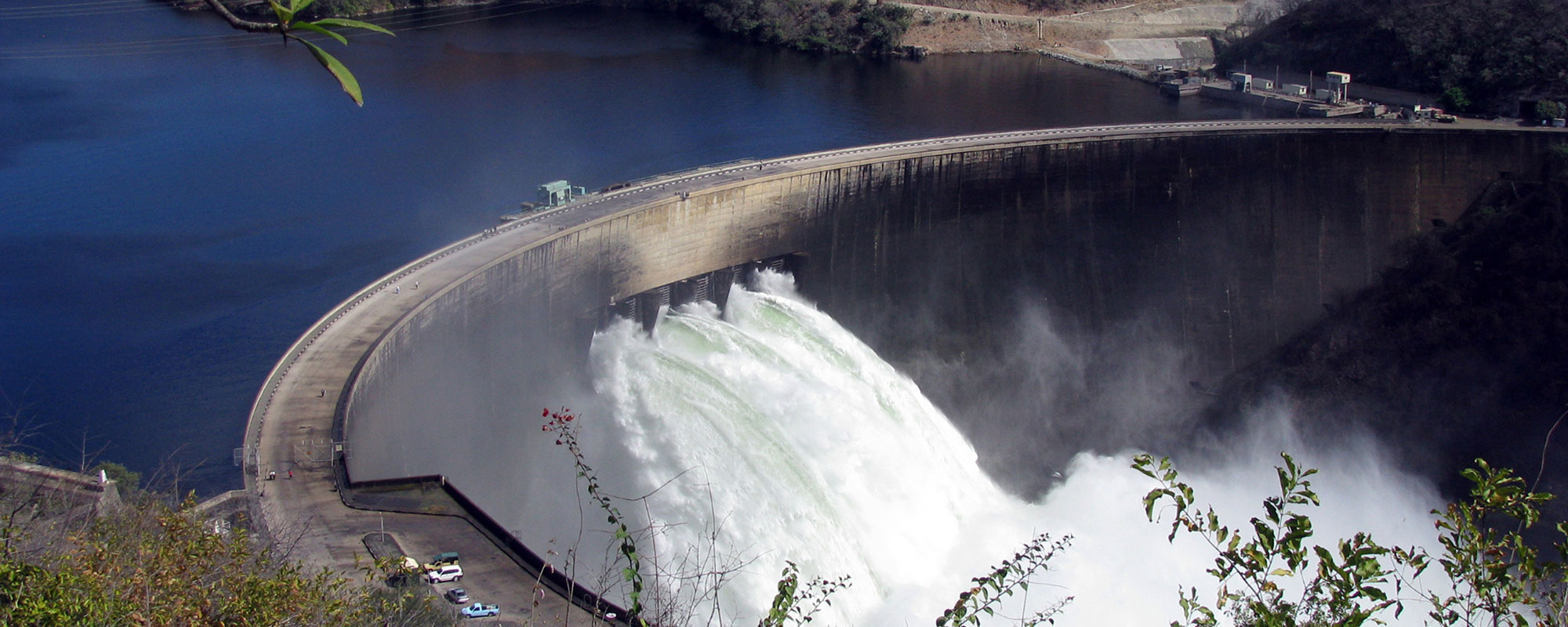
The dam was an initiative of the federation existing at the time between British ruled Northern and Southern Rhodesia (now Zambia and Zimbabwe) and Nyasaland (Malawi). To dam the great Zambezi floodplain was in many ways a hopeful leap into the future. Vast areas of forest and scrub would be inundated. Literally thousands of wild animals would lose their habitats and, more importantly, the local villages would have to be relocated. Analysis of the economic advantages convinced the authorities that the ultimate benefit to the people would outweigh the loss of wildlife and disturbance to residents’ lives.
The vegetation was strip cleared and burnt, making the lake rich in chemicals from the fired wood and the considerable number of remaining trees provided an essential habitat for many creatures that found their way into the lake.
Building the dam wall began in the late 1950s. Well over a million cubic metres / three million cubic feet of concrete was poured into the 36.6 metre-high / 121 feet wall with a thickness of over 24m / 79ft to sustain the pressure of nearly ten million litres of water passing through the spillway each second. At the end of 1958, the sluice gates were closed and in 1963 the maximum level was reached.
The Zambezi River rises in north-western Zambia and its catchment area covers 1 352 000km² / 84 000mi² and eight countries, namely Angola, Botswana, Malawi, Mozambique, Namibia, Tanzania, Zambia and Zimbabwe. It enters the Indian Ocean in Mozambique at Quelimane.
It flows for some 2 650km / 1 647mi from its source to the Indian Ocean. It is the fourth largest river in Africa flowing into the Indian Ocean.
Kariba Dam is located approximately halfway down the Zambezi River.
The Electricity Supply Commission instigated an investigation for possible hydroelectric schemes to be situated at Kariba and in 1941 funds were allocated. As a result of this survey, a river gauging station was set up at Chirundu as well as at a campsite 25km / 16mi downstream from the present dam wall.
Both Southern Rhodesia (Zimbabwe) and Northern Rhodesia (Zambia) were in contention as it was thought that the Kafue River Gorge site in Northern Rhodesia was preferable to Kariba. The matter was solved in 1951 by a board of experts known as ‘The Panel’ who all agreed that the dam be built on the Zambezi River, at the Kariba Gorge site.
In August 1955, the then Federal Government of Rhodesia and Nyasaland (Zambia, Zimbabwe and Malawi) called for tenders for the construction of the wall and power station was awarded to the Italian consortium Impresit on 16 July 1956.
Kariba Dam was designed by the French engineer and inventor Andre Coyne. A specialist in arch dams, he personally designed over 55 dams.
NYAMINYAMI
The name Kariba (from kariva – meaning trap) refers to a rock that thrusts out of the swirling water at the entrance to the gorge close to the dam wall site, now buried more than a hundred feet / thirty metres below the water surface. In many legends, this rock was regarded as the home of the great river god Nyaminyami, who caused anyone who ventured near to be sucked down for ever into the depths of the river.
When the valley people heard they were to be moved from their tribal lands and the great Zambezi River blocked, they believed it would anger the river god so much that he would cause the water to boil and destroy the white man’s bridge with floods.
In 1957, a year into the building of the dam, the river rose to flood level, pumping through the gorge with immense power, destroying some equipment and the access roads. The odds against another flood occurring the following year were about a thousand to one – but flood it did – three metres / 10 feet higher than the previous year, this time destroying the access bridge, the coffer dam and parts of the main wall. Nyaminyami had made good his threat. He had recaptured the gorge. His waters passed over the wreckage of his enemies at more than sixteen million litres / four million gallons a second, a flood which, it had been calculated, would only happen once in ten thousand years. Although man eventually won the battle when the dam was finally opened in 1960, there was a whole new respect for the power of the river god.
THE DISPLACED TRIBE
Within the area lived over fifty thousand people, mostly of the Batonga tribe, many of whom were vehemently against moving. Although land was set aside for them further up the valley, they were reluctant to leave their tribal lands and felt the move from the riverside would displease Nyaminyami. When the floods came and did in fact destroy parts of the bridge, this only served to confirm their fears. It took many months of reasoning and coaxing to convince the people that the bridge would provide power – a luxury they had no knowledge of – for the whole country. Eventually, however, when the trucks moved in to relocate them, they conceded, having little choice. Ceremonies were held to honour their gods and the journey to new lands began. Schools and clinics were built in some of the new areas and wells installed for their arrival. Some new villages that were relocated close to the water’s edge have prospered with the new fishing opportunities on the lake. But many mourn the loss of the rich alluvial river soil and battle to produce crops in the higher sandier areas. For the most part, the move was a severe disruption of their way of life and compensation minimal.
In recognition of this, the Zambia Electricity Supply Company (Zesco) has established the Gwembe-Tonga project that aims to address some of the environmental and social issues which came about following the construction of the dam.
Road rehabilitation, the provision of a clean water supply, electrification, construction of schools, improving agricultural production, provision of technical assistance and health improvement are the core issues that the project will grapple with.
In order to avoid some of the mistakes of the past the local communities are being involved in all stages of the project. The project implementation strategy will be based on a cost-sharing basis with the beneficiary and other resources while the community will be expected to provide manual labour and some raw materials.
OPERATION NOAH
As the dam began to fill, it became evident that thousands of animals were being stranded on islands. Appeals were made and money raised to buy boats and equipment for their rescue and relocation.
This project became known as Operation Noah. It was a mammoth task and beset by numerous hazards. Submerged trees and stumps threatened the hulls of the boats and on the islands there were huge concentrations of snakes including the deadly black mamba. Even so, many were successfully rescued.
One story tells of a game ranger who climbed a tree in a swimming costume and gloves to catch a mamba with a noosed stick. Another tells of the rescue of a black rhino stranded on a small island. The animal was pursued for several hours until eventually it was driven past a marksman with a crossbow loaded with a muscle relaxing dart.
Suitably sedated, the rhino was rolled on to a sledge, dragged ashore and loaded onto a raft buoyed up by eighteen petrol drums. Raft, rhino and all were then towed to the mainland some 19km / 12mi away. An astonishing 44 rhinos were rescued in this way. In all, some 7 000 animals were saved during Operation Noah.
But there were many utterly tragic stories too. Scenes of stranded monkeys perching on treetops, unable to swim to shore, starving, every bit of greenery on the tree long eaten, their skins rotting in the water and too afraid of humans to allow themselves to be rescued. Countless smaller animals, reptiles and insects simply drowned.
It is a reflection of the dominance of colonial rule in Salisbury, Southern Rhodesia, that most of the rescued animals were relocated to the Zimbabwean side and most of the people, to the Zambian side.