Zambia Tourism Board


  HOME

  TOUR & SAFARI Co's

  PLACES TO VISIT
  
 Victoria Falls
   Zambezi River
 
   Lake Kariba  
   Lake Tanganyika  
   Other Waterfalls  
   Chimp Sanctuary
   Shiwa Ngandu 
   Lake Bangweulu 
   Livingstone Memorial 
  
Lake Mweru 
   Monuments 
   Museums
   Art Galleries
 
  GAME RESERVES

    South Luangwa
   North Luangwa
   Lower Zambezi
   Kafue 

   Sumbu
   Lochinvar
   Nyika
   Sioma Ngwezi
   Kasanka
   Bangweulu Wetlands
  
Liuwa Plain
   Mosi-o-Tunya
   Luambe
   Blue Lagoon
   Other Smaller Parks

  CITIES & TOWNS
    
Lusaka
 
 Livingstone  
  
The Copperbelt  
 
 Other Towns


  SAFARIS
   
Walking Safaris
 
 Birding Safaris
 
 Canoeing Safaris
 
 Mobile Safaris
   
Elephant Back Safaris
   Horse Back Safaris
  
Photographic Safaris
 
 Open Vehicle Safaris

  ADVENTURE/SPORTS
   Driving around Zambia

   
White Water Rafting

   River Boarding
   Bungi Jumping
   Abseiling
   Gorge Swinging
   Horse Trails
  
Tandem Kayaking
  
Canoeing/River Safaris

   House Boating
   Tiger and Fly
Fishing

  WILDLIFE
    Illustrated Checklists

  BIRDLIFE
     
In depth synopsis
   
Checklists

  DIRECTORY
     Adventure Companies
    Airlines
   
Air Charter

    Art Galleries
    Backpackers
    Campsites & Chalets  
   
Car Hire
   
Coaches / Buses

    Embassies
    Emergency Numbers
    Fishing Camps
    Game Lodges
    Golf Courses
    Private Reserves

    Govt Offices
    Guesthouses
    Hospitals
    Hotels
    Safari Operators
    Tours

   
Trains
    Travel Agents

  TRAVEL INFO
   Quick Facts

  
Getting There
   
Getting Around
   Handy Information
  
Visa Info  

  PEOPLE
   History
   Culture
  
Major Tribes
  
Ceremonies 


  ENVIRONMENT
   Geography
   Vegetation
   Conservation

   MAPS

  PHOTO GALLERIES

  LINKS

  TRAVEL NEWS

  ENQUIRIES

  ADVERTISING


ZAMBIA'S VEGETATION
© Mike Bingham

While it is true that Zambia lacks the spectacular mountains of most of its neighbours, it has more intact miombo woodland than any other country. It also has many large lakes, and vast floodplains. The Zambezi and several of its tributaries are larger than any river to the south of the Zambia. There are more large and spectacular waterfalls than in the whole of the rest of the subcontinent, including five major waterfalls on the Kalungwishi river system alone.

Zambia occupies a central position in the Zambesian Region, which is the summer-rainfall belt of southern tropical Africa. Within the region the natural vegetation is largely determined by altitude, rainfall and soils.

Common names. In countries where the English language has been in use for centuries, such as the United States, South Africa and Australia, many plants are known by common English names. Zambia has a vegetation quite different from those countries and very few species have accepted English names. The tendency to borrow names like "Wild Medlar" is of little help to local Zambians who are never likely to see a medlar, and would not recognise the similarity if they did. Ecologists in this country have preferred to use one of the local names. There is no problem with "mopane" or "baobab", which are established internationally, but there seems little point in coining a whole new system of names when all plants already have names. It is true that some (but not all) of the botanical names are difficult, but for the meantime there is little alternative.

Ecological zones. Zambia can conveniently be divided into the following ecological zones:

  • Plateau with higher rainfall
  • Plateau with medium rainfall
  • Montane
  • Kalahari Sand with higher rainfall
  • Kalahari Sand with medium rainfall
  • Valley


Plateau

Most of Zambia consists of flat plateau at altitudes ranging from about 1000m to 1500m. At this altitude the climate is mild, with maximum temperatures rarely exceeding 35 degrees Celsius. The rainfall decreases from north to south. The 1000mm isohyet corresponds approximately to the boundary separating the four northern provinces from the five southern provinces. This also approximately demarcates an important ecological boundary between the higher-rainfall miombo and medium-rainfall miombo zones. In the higher rainfall areas the traditional staple crop is cassava (although this is changing) and there is no tradition of keeping cattle. In the medium rainfall areas, the traditional crop is maize (although recent droughts and loss of cattle through disease have forced changes here too) and there is a long tradition of keeping cattle.

MIOMBO WOODLAND. It never fails to come as a surprise to newcomers to the region that many of the woodland trees start their growth cycle in August and September, long before the onset of the rains in November. The flush of new foliage, in spectacular shades of red, is a wonderful sight, and the evening fragrance of the Brachystegia flowers three weeks later lends an air of magic after the heat of the day.

Miombo woodlands are generally considered to be deciduous, but they are neither strictly evergreen nor deciduous. They are best regarded as semi-evergreen. Muputu Brachystegia spiciformis is evergreen in good years and on the more favourable sites, and deciduous in dry conditions.

The name "miombo" is the plural for "muombo", the Bemba name for Brachystegia longifolia, a tree which dominates extensive areas of the Zambesian plateau. Miombo is regarded as woodland, in spite of its closed canopy (with crowns touching), because of its light foliage which allows sufficient light to reach the ground to support a continuous ground cover of grasses and other herbs. Since this herbaceous ground cover dries out and burns most dry seasons, miombo woodland is regarded as a "fire climax", a vegetation type which is maintained by regular fires.

Some woodlands on steep or shallow soils are naturally protected against burning, but retain their woodland structure because of the nature of the soil. Other areas cannot burn because of heavy grazing pressure by cattle. Such areas tend to become heavily invaded by shrubs.

Miombo woodland is defined as any woodland which is dominated by species of three related genera in the family Leguminosae: Brachystegia, Julbernardia and Isoberlinia. Unlike most other leguminous plants, these do not develop nitrogen-fixing nodules on their roots.

Two features which these trees have in common are the characteristic mushroom-shaped crown, and that they disperse their seeds by the explosive dehiscence of their pods. The violent twisting of the two valves of the pod flings the seeds to a distance of up to 25 metres.

Miombo woodland is also rich in herbs and subshrubs. Regular burning is necessary for their maintenance. Unburnt dead grass suppresses new growth. Mowing has the same effect as burning, indicating that it is the heat of sunlight on the ground which stimulates new growth. Grazing, however, can be detrimental to the more sensitive herbs, such as orchids and milkweeds, Asclepiadaceae. Miombo woodland provides poor grazing except during the rainy months, when the grasses are young. Since this is also the growing season of most other herbs, they are most vulnerable to damage by trampling at that time.

MIOMBO FOREST PRODUCTS . Miombo woodland produces a great range of valuable forest products. The chief source of indigenous hardwood timber is mukwa, Pterocarpus angolensis, which is logged by pitsawyers in almost every district in the country. Government restrictions on exports have resulted in a serious undervaluation of mukwa which has led to wasteful usage. Another very valuable product of miombo are edible caterpillars, ifinkobala, of emperor moths Saturniidae, which are harvested in great quantities in certain areas, and sold dried in the urban markets. The foodplant of the most important commercial species is mutondo, Julbernardia paniculata. This species, which may well be the most common tree of Zambia, is also the most important source of nectar for honey. Unlike the other miombo dominants it flowers after the rains, thus providing a second honey flow. Because there is little else in flower at that time the honey is less contaminated than Brachystegia honey. Traditional bark-hive beekeeping has been practised by the Lunda people of Mwinilunga and Kabompo districts for centuries.

HILLS AND ESCARPMENTS. Steep slopes and rocky outcrops are generally protected from fires by the sparseness of the grass cover. The good drainage on slopes ensures that the soil remains friable and free from compaction. These areas are consequently rich in many of the more fire-sensitive plant species. Smooth-barked trees and thicket clumps are characteristic features of the vegetation. Hills of limestone and other basic rock types may develop deciduous thickets, with pockets of rich herbaceous vegetation.

Characteristic of these hill slopes are the smooth-barked species of Brachystegia B. bussei, B. glaucescens and B. microphylla, and the white-barked Sterculia quinqueloba. Miombo species can only be supported where there is sufficient soil to sustain them. Elsewhere deciduous species predominate.

DRY EVER-GREEN FORESTS. The best quality miombo woodland may grade into dense evergreen forest, especially at dambo margins, or where there are laterite pavements. Like other forest types they are protected from fire by having no flammable ground cover of grasses and herbs. Two of the most characteristic species are mufinsa, Syzygium guineense subspecies afromontanum, which is frequently dominant, and mofu Entandrophragma delevoyi, which occurs as an occasional emergent, and is one of the tallest of Zambia's indigenous trees. Some of the best of these forest, which are seriously threatened by clearing for cultivation, are to be found in the southern parts of Copperbelt Province. The best quality miombo woodland may grade into dense evergreen forest, especially at dambo margins, or where there are laterite pavements. Like other forest types they are protected from fire by having no flammable ground cover of grasses and herbs. Two of the most characteristic species are mufinsa, Syzygium guineense subspecies afromontanum, which is frequently dominant, and mofu Entandrophragma delevoyi, which occurs as an occasional emergent, and is one of the tallest of Zambia's indigenous trees. Some of the best of these forest, which are seriously threatened by clearing for cultivation, are to be found in the southern parts of Copperbelt Province.

DAMBOS. Owing to the flatness of the terrain drainage on the plateaux is provided by flat-bottomed valleys called dambos. The water level in dambos rises and falls with the seasons. This annual rise and fall in the water level has a number of consequences. Since trees cannot withstand flooding for any length of time the absence of trees marks the highest level to which the water rises. Owing to the flatness of the terrain drainage on the plateaux is provided by flat-bottomed valleys called dambos. The water level in dambos rises and falls with the seasons. This annual rise and fall in the water level has a number of consequences. Since trees cannot withstand flooding for any length of time the absence of trees marks the highest level to which the water rises.

Dambos are features of intense biological activity. It has been observed that elephant prefer to dig for water at the dambo margins rather than taking surface water from the channels. The reason for this is that the water entering the dambo contains minerals, which are adsorbed by clay or taken up by living organisms in their passage through the dambo soil.

Dambos which are permanently wet but have sufficient slope to avoid being flooded, develop into acid peat bogs. These provide habitats for raffia palms, Raphia farinifera, orchids and many other interesting plants. Denitrifying bacteria deplete the soils of nitrogen compounds, thus providing habitats for insectivorous plants, such as Drosera and Utricularia.

Water draining these peat bogs is often black owing to high concentrations of tannins which are leached from the vegetation. Tannins are defensive chemicals which inhibit the digestion of protein by animals. Tannin-producing plants are prevalent in areas of nutrient deficiency, where competition for available nutrients is particularly intense. Black-water rivers are well known to be deficient in animal life.

The grasses and sedges of poorly drained acid dambos are extremely unpalatable to herbivores. However when the soils of these areas are disturbed by heavy trampling, which breaks down the soil structure, palatable grasses may invade. These areas attract grazing animals, thus extending the replacement of sedges by palatable grasses.

Much of the upper and middle course of the Kafue River, upriver of Kafue National Park, is flanked by wide dambos, consisting of sedge grassland, whereas in the park the vegetation along the river is mainly short grasses. The latter is kept in a palatable state by grazing and by drainage provided by paths made by hippo to and from the river. Where these animals have been eliminated by hunting the drainage is poor, the soils acid and the vegetation unpalatable.

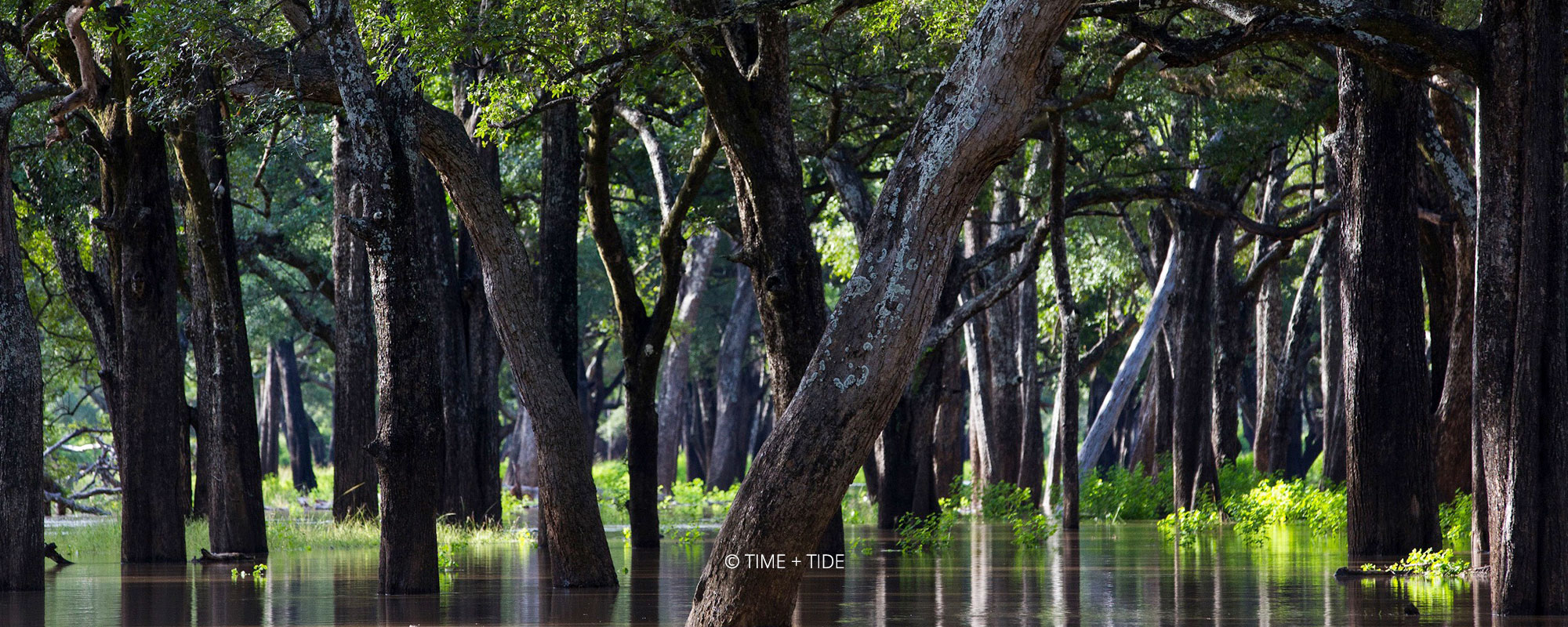
SWAMP FOREST. Dambos in the higher rainfall area frequently have patches of swamp forest (mishitu in Bemba). These, as the name implies, have wet floors. Some are very rich in species while others consist of just one, musombo Syzygium cordatum. Some of the largest and richest occur in the Mpongwe area of Copperbelt Province. Since the soils cannot be used for cultivation people do not make much use of these forest, and rarely enter them. The dominant musombo does, however, produce fine honey.

FLOODPLAINS. The many extensive floodplains of Zambia have formed where large rivers cross flat plateaux. The Zambezi River and several of its tributaries form a very extensive system of plains in Western Province and the western part of North-western Province. The Kafue River has large floodplains on two of its tributaries, the Lufupa (Busanga Plain) and the Lukanga, in addition to the Kafue Flats. The Chambeshi River enters the Bwela flats near its source, and spills in the vast Bangweulu swamp, which is drained by the Luapula River.

These plains all have rich and distinctive floras. Large areas of floodplain may be inundated for the whole period of the dry season during wet spells, but may not flood at all during dry years. Such areas have two complementary floras, one aquatic and the other adapted to dryland conditions. The aquatic flora consists of a variety of species, such as the wild rice Oryza longistaminata, which are rooted in the ground, and have stems which elongate to keep pace with the rising flood, so that the leafy tips are always above water. The water may rise 4 metres or more. As the flood recedes the vegetation lies down to form a dense mat.

Characteristic of the elevated levees and the higher levels of the plains are groves of fan-palms, Borassus aethiopum and Hyphaene petersiana, the former with a characteristic swelling on the bole. Termite mounds on sandy floodplains frequently have the wild date-palm Phoenix reclinata.

TERMITE MOUNDS. Most woodlands and many dambos have large termite mounds, which are frequently covered with dense woody vegetation. As a general rule the plants growing on these mounds are forest species of trees and climbers, but the variety of termite mound vegetation is enormous. What is nearly always apparent is that it is very different from the surrounding vegetation. Yet there are exceptions even to this rule.

There are large tracts of miombo woodland on the plateaux which lack termite mounds. The most extensive areas are the Kalahari Sands, where the soils simply have not enough clay to support stable mounds. In many rocky areas, and on steep slopes, where the soil depth is limited, mounds are generally absent. Mounds are most consistently found at the dambo margins, where the optimal conditions of drainage and an abundance of suitable clay exist.

Termite mounds undoubtedly have long lifespans, measured in centuries. Old trees associated with mounds suggest this, and archaeological evidence confirms it.

Some species are highly adapted to termite mounds, such as the large succulent tree Euphorbia ingens, which superficially resembles some of the New World cacti, but is in fact unrelated. Other trees, notably the Proteas, are never to be found either on or even near termite mounds.

Termite mounds accumulate mineral salts. They are frequently rich in lime even when the surrounding soils are deficient. This accounts for the preponderance of lime tolerating plants on mounds. In some areas mounds are rich in salt, and these attract animals which eat the soil. Even well fed cattle on commercial ranches cannot resist salty termite mounds, eating away the soil to form a grotto and eventually demolishing the whole mound.


Montane Vegetation

Zambia has very little montane vegetation. Four mountains exceed an altitude of 2000 metres: the Nyika Plateau, which is mostly in Malawi, the Mafinga Mountains, also on the Malawi border, Mukutu, an isolated block in Isoka District to the west of the Nyika Plateau, and another isolated peak, Sunzu, south-east of Mbala.

Montane vegetation consists mostly of four types, sub-montane forest, miombo woodland, macchia-type scrub and grassland. The Zambian Nyika has two fine sub-montane forests, Chowo and Manyenjere, and Mukutu also has another. Similar sub-montane forest occurs throughout northern Zambia, notably at the sources of the Zambezi, Lunsemfwa and several other large rivers, and also along the upper escarpments of the Luangwa and Luapula rivers.

High altitude miombo woodland is usually stunted, the trees seldom growing more than about 6 metres high, and often as little as 2 metres. They are thickly encrusted with lichens and epiphytic orchids.

The macchia-type scrub includes many shrubs in the families Proteaceae: Protea and Faurea and Ericaceae: Erica and Agauria and Compositae (especially Helichrysum spp., the "everlastings").

Montane grassland is much more extensive than forest. It is extremely rich in flowering herbs, which are seen as their best in the months after the rains, March - May. After the fires these areas appear desolate, but without the fires the grassland would turn to scrub, and would lose its herb flora.

Sub-montane areas, at elevations above 1400m, are much more extensive. The flora is less distinctive than the vegetation of the high mountains, but is nevertheless varied and rich. In the vicinity of the Kundalila Falls in Serenje District. More than 360 species of orchids in five different habitats have been recorded (Williamson).


The Kalahari Sands

Although the Kalahari Sand areas of western Zambia are part of the southern African plateau the soils and vegetation are so different from those elsewhere that they are always treated as a distinct entity by ecologists. Kalahari Sand derives its name from the Kalahari Desert, which has undergone considerable expansions many times during its geological history. The Kalahari Sands, which have been described as the largest sand sea in the world, extends from the northern Cape Province, in South Africa, to well north of the equator. They are recognised by microscopic examination of the sand grains, which are rounded and pitted as a result of abbrasion while being blown about. In the present Kalahari Desert of Botswana significant dune movement only occurs where the annual rainfall is less than 150mm. The expansions of desert on either side of the equator have depleted the African flora, which is not nearly as rich as South America and other tropical regions.

The main differences between the Kalahari sands and the rest of the Zambian plateaux are attributable to the very deep, free-draining soil with virtually no clay or silt. Such soils provide an excellent growing medium for deep-rooting woody plants. Since it is deficient in clay the soil can only hold nutrients where there is organic matter. Exposure of the soil surface to the sun destroys much of the organic matter and such areas tend to remain bare.

KALAHARI SAND WETLANDS. On the west side of the Zambezi, where the relief is low, there are large plains which barely rise above the high flood level. In Liuwa National Park near the Angolan border there are treeless plains where there is no tree visible above the flat horizon in all directions.

Although the topland areas are deficient in clay and soil nutrients this is not the case with the plains and dambos, which are of great importance for grazing cattle and crop growing. In Sesheke and Senanga Districts the sand overlies old river beds which are rich in clay and lime. These areas can usually be recognised by the presence of termite mounds.

KALHARI SAND VEGETATION TYPES. There are two types of dryland forest, mavunda or Cryptosepalum forest, which occurs mainly in the northern higher-rainfall areas, and mukusi (Baikiaea or Zambezi Teak) forest, which occurs mostly in Sesheke, Senanga and Kalomo Districts, as well as in the adjacent areas of neighbouring countries.

MAVUNDA is classed as a dry-evergreen forest type, consisting of a very dense evergreen shrub matrix, mostly about 4m in height, with a fairly light overwood in which Cryptosepalum exfoliatum subspecies pseudotaxus (mukwe) is the dominant tree. The two main blocks of mavunda, occurring respectively to the north and south of the Kabompo river, constitute the largest area of tropical evergreen forest in Africa (and probably in the world) outside the equatorial zone. Small outliers of mavunda occur as far south as Sesheke District.

MUKUSI FOREST is deciduous and occurs in an area of much lower rainfall than the mavunda forests. Again it consists of a dense thicket with a lighter overwood, but the species are entirely different. The overwood species is mukusi (Zambezi teak), with one or two other species coming into forests of slightly inferior quality. is deciduous and occurs in an area of much lower rainfall than the mavunda forests. Again it consists of a dense thicket with a lighter overwood, but the species are entirely different. The overwood species is mukusi (Zambezi teak), with one or two other species coming into forests of slightly inferior quality.

Zambezi (or Rhodesian) teak supported a major timber industry in the first half of the century, supplying enormous quantities of railway sleepers and parquet flooring. Without this timber resource the rail through to the Copperbelt and Lubumbashi, in Zaire, would undoubtedly have taken much longer to complete. Production of mukusi timber peaked at 100,000 cubic metres per annum in the 1930s and again in 1964. Since then there has been a steady decline, and a recent inventory undertaken by the Japanese aid agency found no further exploitable reserves in the prime teak forest areas of Sesheke District.

As with other indigenous African timbers, exploitation has destroyed the forests, with little hope of recovery. Any opening up of the forest results in the invasion of grasses and fires. Mukusi will survive as a woodland tree, but in this habitat it never achieves the same size as in the forests. The German aid agency has embarked on a 15-year programme to try to find out how to rescue what remains of the teak forests.

KALAHARI WOODLAND, DAMBOS. PANS. Most upland Kalahari sand carries woodland vegetation which is similar to miombo. On the deep sands of the plain east of the Zambezi there are a few major rivers in the form of wide dambos. These are highy productive areas. Also on this plain are numerous "blow-outs", or wind-scoured pans, which are remnants from previous desert conditions. Many are seasonal swamps. These dambos and pans of the Kalahari Sand provide a fine thatch grass, Loudetia simplex (mwange in Lozi) for which Western Province is famous.
Most upland Kalahari sand carries woodland vegetation which is similar to miombo. On the deep sands of the plain east of the Zambezi there are a few major rivers in the form of wide dambos. These are highy productive areas. Also on this plain are numerous "blow-outs", or wind-scoured pans, which are remnants from previous desert conditions. Many are seasonal swamps. These dambos and pans of the Kalahari Sand provide a fine thatch grass, Loudetia simplex (mwange in Lozi) for which Western Province is famous.

The Bulozi floodplain. This vast area of wetland is one of the most important areas for the production of fish and cattle in southern Africa. The depth of flooding of the Zambezi and its tributaries varies considerably from year to year, which makes both cropping and cattle keeping somewhat dependent on chance. In years of high rainfall the floods recede slowly and the cattle suffer, because the grazing off the plain is of poor quality.

Western Province is the source of some of the finest crafts in southern Africa. The most skilled are the Mbunda and Nkoya people, both of whom use mukenge, the root fibres of the tree Combretum zeyheri for weaving basket work which is much sought after on international markets. These tribes also make very fine bows and arrows, which are still used in hunting.


The Valleys

Several deep rifts traverse the eastern and southern parts of Zambia, forming the southern end of the great East African rift system. These rifts, or troughs as geologists prefer to call them, vary in depth. The two deepest are the valleys of Lakes Tanganyika and Malawi, which, with Lake Baikal, are world's deepest lakes.

The valleys of the middle Zambezi and the Luangwa and its tributaries, the Lukusashi and Lunsemfwa, are all approximately 300m in depth. The Kafue Flats form yet another valley trough, although the altitude, about 975m, is only slightly less than the surrounding plateaux, and there are only minor escarpments.

All of these valleys have been formed by down-faulting. The rocks of the valley floors date from the Karroo period. Fossil bones of mammal-like reptiles (Therapsids), which preceded the dinosaurs, have been found in a few places.

Soils derived from the Karroo sandstones generally have a higher mineral content than those derived from the basement complex of the plateaux, and the contrast in the vegetation is sharp. The Luapula valley is not part of the rift valley system and belongs to the basement complex. Its natural vegetation is not miombo, and although it resembles the vegetation of the other valleys in structure, the species are quite different.

Valley vegetation consists of complex mosaics. It is affected by the drainage pattern and soils, and also by large herbivores which are concentrated in these nutrient-rich areas. Deciduous thickets commonly occupy the well drained sites. The banks of rivers and lagoons have riverine fringing forest. The slopes between the thickets and the riverine forest are frequently covered with mopane woodland. Grassy plains occur on cracking clay soils. Lagoons, which are frequently formed as ox-bow lakes, have a rich variety of aquatic vegetation. At the lower end of the mopane slopes there are frequently large termite mounds covered with forest species. These mounds are often partly or completely encircled by pans, which hold water for several months into the dry season. These pans begin as wallows and are extended as more mud is carried out on animals using them.

MOPANE AND MOPANE WOODLAND. Mopane Colophospermum mopane is a very distinctive species familiar to anyone who has visited the Luangwa or Zambezi valleys, where it forms extensive pure stands on the valley floor and lower escarpment slopes. Most people associate mopane with the hot dry valleys, but it also occurs quite extensively on the southern plateau. Its distribution in Zambia is strongly correlated with Karroo sandstone, dating from the Triassic period, which occurs in a number of down-faulted troughs in the much older surrounding basement complex.
Mopane Colophospermum mopane is a very distinctive species familiar to anyone who has visited the Luangwa or Zambezi valleys, where it forms extensive pure stands on the valley floor and lower escarpment slopes. Most people associate mopane with the hot dry valleys, but it also occurs quite extensively on the southern plateau. Its distribution in Zambia is strongly correlated with Karroo sandstone, dating from the Triassic period, which occurs in a number of down-faulted troughs in the much older surrounding basement complex.

In the drier parts of its distribution range mopane may dominate most soil types, but on the plateau it is confined to particular soil types, which are alkaline and contain high concentrations of sodium salts. The clays in these soils swell on absorbing water, and rapidly become completely impervious.

These conditions are unfavourable to the growth of most trees, and the few species that do tolerate them must be adapted to take up water rapidly for the short time it is available. In fact mopane develops a superficial root system which is able to suppress perennial grasses, and it is not uncommon to observe isolated trees in a circle of taller perennial grass, with only sparse annual grasses and herbs under the trees. This suppression of perennial grasses actually promotes surface runoff and soil erosion, and gulleying is a common feature of mopane woodland areas.

The soil characteristics of mopane woodland are in complete contrast to those of miombo woodland, which conserves both soil and water. Yet mopane can grow on deep, well-drained soils, and many of the finest specimens are on such soils. In these circumstances it develops a deep taproot like its woodland associates. Yet it is evident from its distribution that it cannot compete with Brachystegia species and the other miombo dominants.

Besides miombo and mopane there are other woodland types, mostly of minor occurrence. They are generally more open in structure than miombo, and lack the characteristic miombo dominants. They occur in situations which are either too dry for miombo, or become too wet during the rains, or suffer from fires too severe for the miombo species to tolerate.

ANIMAL-MODIFIED VEGETATION. The unnaturally high population densities of herbivores in the more popular national parks have greatly modified the natural vegetation. The constant trampling and browsing of animals effectively prevents any but the best protected species from getting started. Most trees become established as seedlings in dense thickets, which are not attractive to large animals. In fact we often associate elephant, black rhino and buffalo with dense thickets, but this is an artificial situation brought about by hunting with firearms, which has forced these animals to take shelter in the dense forests and thickets. When left in peace these animals they choose more open habitats and avoid the thickets.

Trees such as the baobab, Cordyla africana, and several other fruit trees become established in thickets, but once these trees mature and their ripe fruits fall to the ground, elephants and other heavy herbivores attracted to the fruits open up the thicket and transform it into a parkland, which is what we see in many of the best game viewing areas in the Luangwa and Lower Zambezi national parks. Since there is no way that these trees can replace themselves their habitats are not sustainable.

Other fruit trees are able to regenerate without the protection of thickets. These include Acacia tortilis, which forms its own spiny thickets, and the two fanpalms, Borassus aethopum and Hyphaene petersiana, which has very coarse foliage which resists browsing.

©Mike Bingham


Google

See the new page
VIDEOS OF ZAMBIA
with short clips on
safaris, wildlife,
Victoria Falls,
adventures and more

CLICK HERE
for
the Tourist Board
Video on Zambia


Photo Gallery Pages
by destination,


Download
Electronic Brochures

* Zambia Highlights

 * Tourism Investment
Opportunities in the
 Kafue National Park


 Find the most 
comprehensive range of 
cheap flights to Lusaka
 chosen by our travel experts


Designed and hosted
by
 
for the
Zambia National

Tourist Board


Contact Webmaster                                Contact ZNTB  offices                         © All text on this site is under Copyright