
THE LUANGWA RIVER
The Luangwa Valley is one of Africa’s prime wildlife sanctuaries, with concentrations and varieties of game and birdlife that have made it world famous. This is the landscape of the ‘Real Africa’, with herds of antelope sheltering under acacia trees or roaming the plains, predators skulking in the shadows and primordial drama in every vale.
The valley lies at the tail end of the Great Rift Valley, that continental fault which runs from the Red Sea down the length of East Africa. This accounts for the spectacular escarpment scenery in East Africa as well as the African Lakes.
As the Rift Valley reaches Zambia, it divides; one arm to the east encompasses Lake Malawi and the western arm becomes the Luangwa Valley, which stretches some 700km / 435mi at an average width of about 100km / 62mi.
In the west, the Muchinga Mountains form the limit of both the valley and the national parks. In the east is a similar, though less well-defined escarpment. The valley floor is about a kilometre / half a mile lower than the surrounding plateau.
Down the centre flows the Luangwa River, fed by dozens of sand rivers that come down during the rainy season. The Luangwa carves a tortuous course along the floor and when in flood rapidly erodes the outer bends, depositing silt within the loops. Eventually the river cuts a new course, leaving the old course to silt up, forming ‘ox bow’ lagoons. These lagoons are very important to the ecology of the riverine zone and account for the high carrying capacity of the area.
The countryside is spectacular in its rugged beauty, the vegetation thick and, near the Luangwa River and its many tributaries, a lush riverine forest occurs that is green all year round. Flanking the river’s western banks are the North and South Luangwa National Parks separated by the 30km / 19mi long Munyamadzi corridor. To the east, between the two main parks lies Luambe, one of Zambia’s smallest national parks. Further east on the rocky uplands beyond the floodplain is the Lukusuzi National Park.
THE HISTORY OF GAME PROTECTION IN THE VALLEY
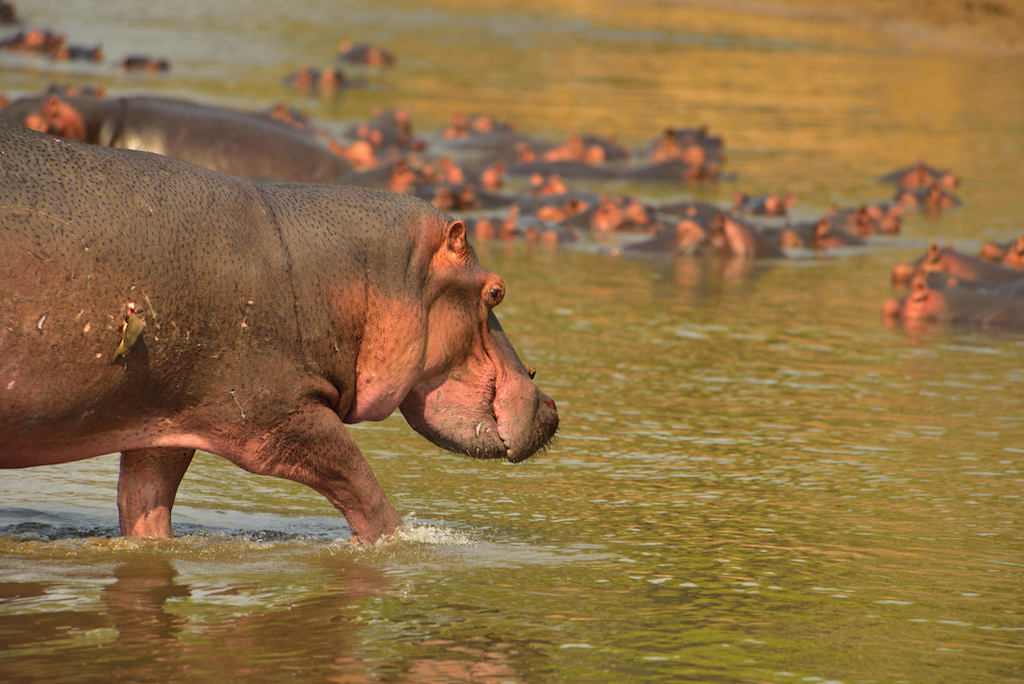
The development of game protection in the area began in the late 19th century when the British South Africa Company was administering the territory. They imposed a total ban on the hunting of hippo and elephant due to massive exploitation by the Chikunda tribe from Mozambique and the Arab traders from Malawi. Today there is a healthy population of hippos along the Luangwa River.
With the recovery of elephant numbers, the BSAC established the first game reserve in the Luamfwa region in 1904, also intending to protect the last remaining species of the endemic Thornicroft’s giraffe. It was deproclaimed in 1911 but then elephant populations began to surge, jeopardising the livelihood of the local villagers. Certain hunters were given licences to shoot the crop-raiding elephants but the desire and avarice to shoot the biggest ones for their tusks was greater. An in-depth survey was completed in 1932 recommending the proclamation of game reserves and the appointment of an elephant control department.
The North and South Parks and Luambe were proclaimed in 1938 and two young men, Norman Carr and Bert Schultz, were appointed as game rangers in 1939. Villages within the reserves were moved to the periphery. In the late 1940s, Carr recommended that hunting safaris be operated here with the revenues going to the local Native Authorities. Game rangers from the department were seconded to act as professional hunters.
In 1951 Carr persuaded one of the chiefs to set aside a portion of his tribal land as a game reserve bordering the park and a safari camp was built there with some of the proceeds going back to the community. Later, a pontoon was erected across the Luangwa River and a few other camps were established. As the years went by, all-weather roads were installed and other safari companies emerged.
In 1973 the elephant population was estimated to be 100 000 and found to be causing a major impact on the surrounding areas but poaching was rampant too and numbers of elephant and the endangered rhino began to decline steadily.
The privately funded Save the Rhino Trust was established in 1980 and extensive anti-poaching patrols were carried out. Elephant poaching was curbed to some extent but rhinos unfortunately could not be saved and today they are entirely absent from the area, the reward from foreigners for their sought-after horns being too great a temptation to the penniless villagers.
Today there are several operators in the valley, spread out along 150km / 93mi of the Luangwa River. They range from budget camps to sophisticated lodges and offer walking safaris, game drives, night drives and photographic safaris. Boating is very limited as the Luangwa River is mercurial and unpredictable.

