
The colourful and sacred Kuomboka ceremony is held each year in Western Province. Dating back 300 years, the festival marks the moving of the King or ‘Litunga’ of the Lozi people to higher ground after summer rains. As the Barotse Plain is flooded by the Zambezi river, the Kuomboka – meaning ‘to rise from the water to dry land’ – ceremony takes place. It will take place on 28 March 2026.
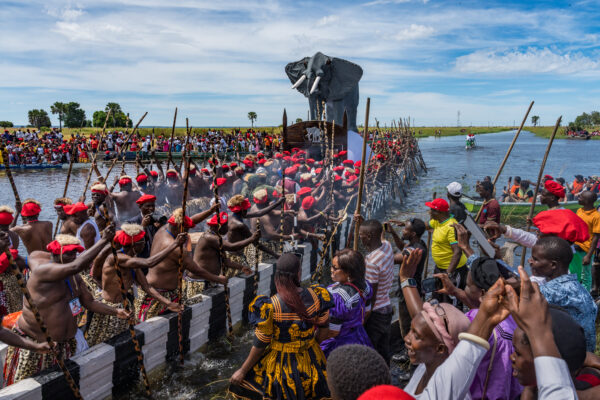
The highlight is the journey of the Litunga on the royal barge – known as the Nalikwanda – from his household at Lealui across the Barotse floodplain. The barge is accompanied by 80 to 100 rowers wielding oars while his subjects beat regal Maoma drums, sing and dance. The Nalikwanda carries a massive carved elephant with moving ears, the symbol of royalty. It is an honour to be chosen as a paddler or rower, a position marked with a scarlet beret. A second barge, called the Nalwange (or egret), carries the queen. The bird’s wings are also designed to move as she progresses along the Zambezi.
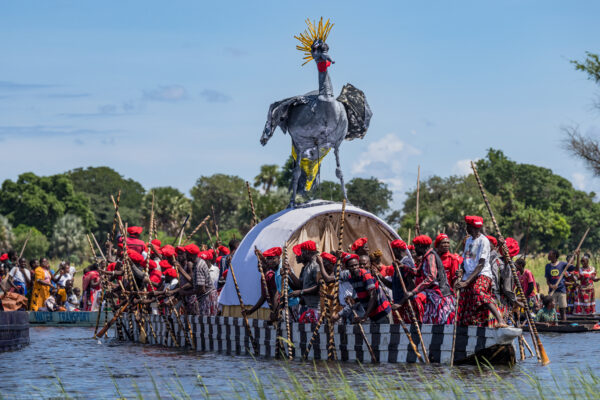
Meanwhile between 200 000 and 250 000 spectators and subjects await the Litunga’s arrival on the bank and his court’s new location at Limulunga. The king returns to Lealui in about August in another festival known as Kufuluhela.
According to Wikipedia, Kuomboka has a rich history:
‘Kuomboka is said to have dated back to the 17th century, when there was a great flood called meyi a lungwangwa.? People were afraid to escape the flood in their little dugout canoes. So it was that the high god, Nyambe, ordered a man called Nakambela to build the first great canoe, Nalikwanda, which means “for the people,” to escape the flood. Thus the start of what is known today as the Kuomboka ceremony. Held annually, the date of the ceremony was based on the height of the water and the moon’s phase. The Litunga consulted the Royal Graves beforehand, after which the royal Maoma drums were sounded to call the paddlers.
‘The first barge was made of reeds and called Njonjolo, though it soon came to be made by wood (reportedly by the first Litunga Mboo). Barges received praise names from Litunga: Mboo’s was called Sitandamwalye, Inyambo’s Lyamashandi, and Ngalama’s Notila. Yeta II used Notila during Kuombokas, but also built a barge called Nalikwanda. Mulambwa’s was reportedly called Njonjolo, though he is said to have maintained Nalikwanda. Tradition attributes the addition of the elephant to Mulambwa, who is said to have ridden one to become heir to the Litunga, after which it became a royal symbol.’
The royal barge is preceded by two scouts that check water levels, and the presence of animals and – in days gone by – the possibility of enemies. The ceremony mixes Lozi tradition with some colonial history, and takes at least six to eight hours. As the barge moves, the crew keep a fire onboard alight as the smoke is a sign to onlookers that the king is still alive. The three most prestigious drums are huge war drums dating at least 170 years.
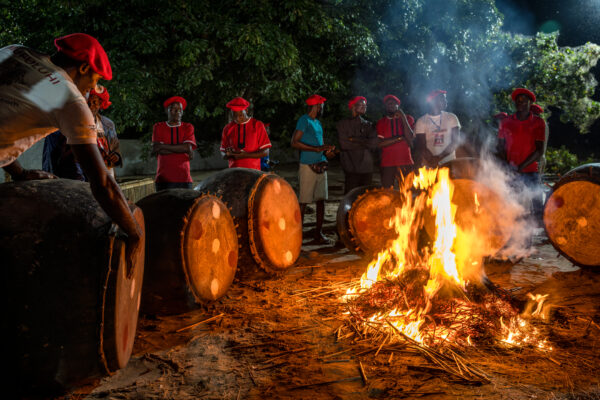
The return trip is usually held in August with a journey called the Kufuluhela.
The Kuomboka shows off Lozi culture and tradition. Outsiders can visit provided they are respectful of the people and tradition, adhere to regulations and requests, and do not hinder the ceremony in any way. It is possible to combine the festival with a safari to nearby Liuwa Plain National Park or even Kafue National Park. Here are some accommodation options in Barotse.
PHOTO CREDIT African Parks | Marcus Westberg

Leave A Comment