
LOCHINVAR NATIONAL PARK
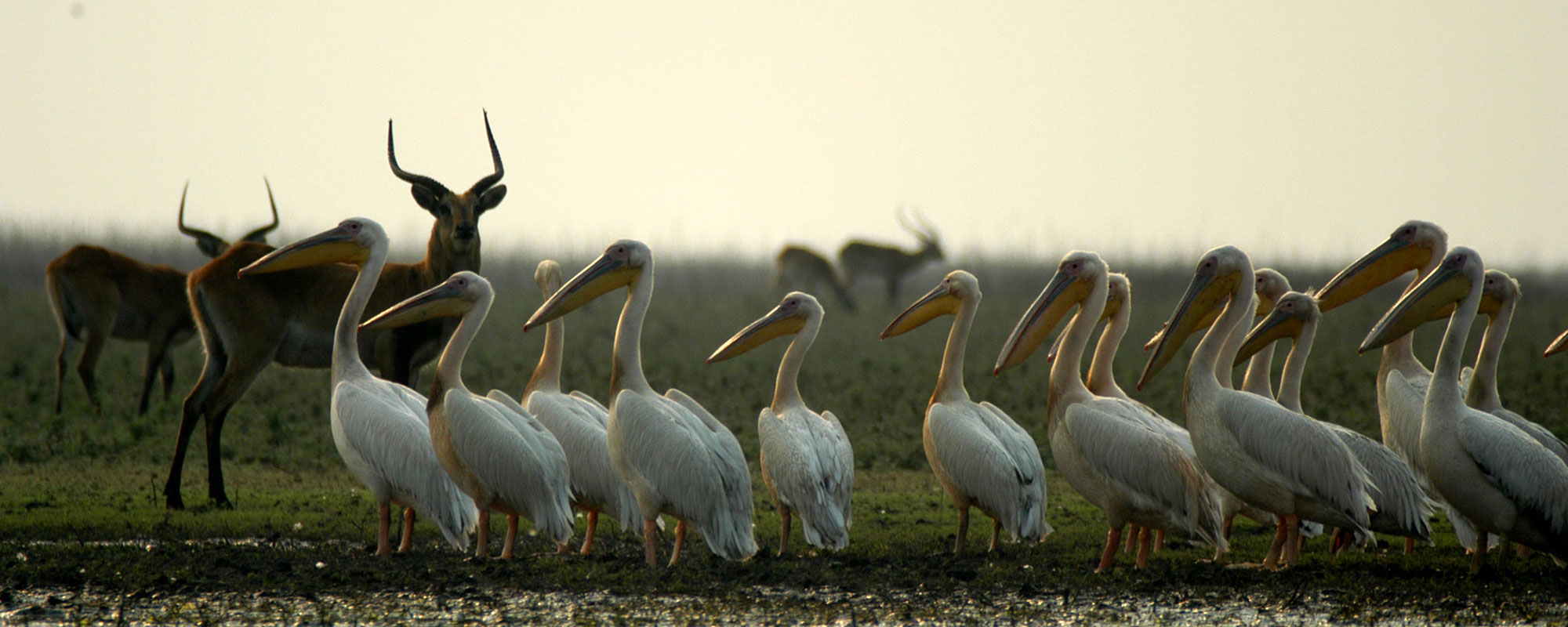
Lochinvar, although not abundant in the larger mammals, is nonetheless a park of exceptional beauty and outstanding birding opportunities with over 420 recorded species in its 428km² / 266mi².
It is situated on the southern edge of the Kafue Flats, a wide floodplain of the Kafue River between Itezhi Tezhi dam in the west and Kafue Gorge in the east. The area extends for 33km / 21mi from the Kafue River in the north to low wooded hills in the south. It includes the large, shallow Chunga Lagoon that fluctuates considerably in size with variations in river levels. The varying vegetation makes it an interesting park to visit with floodplains, woodlands and termitaria.
It is particularly well known for the large herds of Kafue lechwe, unique to the Kafue Flats. Other antelope are the blue wildebeest, kudu, oribi and buffalo. Waterbirds are especially abundant.
The Kafue Flats floodplain, in the northern section, floods from the Kafue River, and here you’ll find thousands upon thousands of the endemic Kafue lechwe, one of three subspecies of lechwe found in Zambia. More than 30 000 of them make the flats their home and move seasonally according to the flood level.
At high water, massive herds may be seen along the upper flood line and in the open grassland further south. As the floods recede the herds move north into the grassy floodplain. They feed on grasses and herbs in water up to a metre / three feet deep and are often seen wading or swimming in the Chunga Lagoon. Mating takes place mainly between December and January. Males fight over small territories known as leks and then mate with several females.
In the termitaria zone, trees and shrubs grow only on the large termite mounds with grasses and herbs covering the rest of the area, which often becomes waterlogged during the rainy season. There are also many small grey mounds that are always unvegetated. The magpie shrike is one of the birds to be seen in the scattered trees of this zone and the surrounding grassy plains are grazed by buffalo, zebra, wildebeest and oribi. Very much in evidence is the candelabra tree.
The southern area is mainly woodland, dominated by Acacia albida and combretum trees and is free from flooding. Bushbuck, kudu, baboon, bushpig and vervet monkey inhabit this area.
The Gwisho Hot Springs occur along a geological fault here, surrounded by lush vegetation and vegetable ivory palms. The water rises by convection from depths of over a kilometre / half a mile with temperatures ranging from 60°C to 90°C / 140°F to 194°F. There are high concentrations of sodium, chlorine, calcium and sulphates in the water. A distinctive rock known as a ‘fault breccia’ occurs along the line of the fault and can be seen at Gwisho.
Sebanzi Hill is an archaeological site which has been excavated. It was the site of an Iron Age village, inhabited until the last century. Look out for The Baobab Tree with a hollow trunk large enough for several people to sleep in. Historically the tree was said to boast special powers that would protect passing travellers from wild animals. There is also a curious rocky outcrop called Drum Rocks, which produces a resonant sound when tapped. They are also part of local superstition and passers-by had to stop and greet the rocks before proceeding.
MORE INFORMATION


LATEST NEWS

Everwild Confirms Operations for 2026 Kasanka Bat Migration Season
Everwild has confirmed that its semi-permanent bushcamp in Kasanka National Park will operate during the 2026 bat migration season, with guests being hosted from 25 October to 1 December 2026. The operation has received the go-ahead from both the [...]
Two Cubs for Sungani Leopardess
A leopardess named Kuvina has been spotted with not one but two cubs by guides at Sungani in one of the most remote areas of South Luangwa National Park. Kuvina has been photographed since 2023 and recently surprised staff when [...]
Six Cheetahs for North Luangwa!
Cheetah are roaming a secure area of North Luangwa National Park for the first time in three decades after six individuals were successfully translocated from South Africa. A joint operation between the Endangered Wildlife Trust and the Zambian Department of [...]