The Complete Travel Guide
 

Zambia Tourism Board


  HOME

.
  TOUR & SAFARI Co's

  PLACES TO VISIT
  
 Victoria Falls
   Zambezi River
 
   Lake Kariba  
   Lake Tanganyika  
   Other Waterfalls  
   Chimp Sanctuary
   Shiwa Ngandu 
   Lake Bangweulu 
   Livingstone Memorial 
  
Lake Mweru 
   Monuments 
   Museums
   Art Galleries

 GAME RESERVES
    South Luangwa
   North Luangwa
   Lower Zambezi
   Kafue 

   Sumbu
   Lochinvar
   Nyika
   Sioma Ngwezi
   Kasanka
   Bangweulu Wetlands
  
Liuwa Plain
   Mosi-o-Tunya
   Luambe
   Blue Lagoon
   Other Smaller Parks

 CITIES & TOWNS
    
Lusaka
 
 Livingstone  
  
The Copperbelt  
 
 Other Towns


  SAFARIS
   
Walking Safaris
 
 Birding Safaris
 
 Canoeing Safaris
 
 Mobile Safaris
   
Elephant Back Safaris
   Horse Back Safaris
  
Photographic Safaris
 
 Open Vehicle Safaris

  ADVENTURE/SPORTS
   Driving around Zambia

   
White Water Rafting

   River Boarding
   Bungi Jumping
   Abseiling
   Gorge Swinging
   Horse Trails
  
Tandem Kayaking
  
Canoeing/River Safaris

   House Boating
   Tiger and Fly
Fishing

  WILDLIFE
    Illustrated Checklists

  BIRDLIFE
     
In depth synopsis
   
Checklists

  DIRECTORY
     Adventure Companies
    Airlines
   
Air Charter

    Art Galleries
    Backpackers
    Campsites & Chalets  
   
Car Hire
   
Coaches / Buses

    Embassies
    Emergency Numbers
    Fishing Camps
    Game Lodges
    Golf Courses
    Private Reserves

    Govt Offices
    Guesthouses
    Hospitals
    Hotels
    Safari Operators
    Tours

   
Trains
    Travel Agents

  TRAVEL INFO
   Quick Facts

  
Getting There
   
Getting Around
   Handy Information
  
Visa Info  

  PEOPLE
   History
   Culture
  
Major Tribes
  
Ceremonies 


  ENVIRONMENT
   Geography
   Vegetation
   Conservation


  MAPS
 
PHOTO GALLERIES
  LINKS
  TRAVEL NEWS
  ENQUIRIES

 ADVERTISING


LOCHINVAR NATIONAL PARK
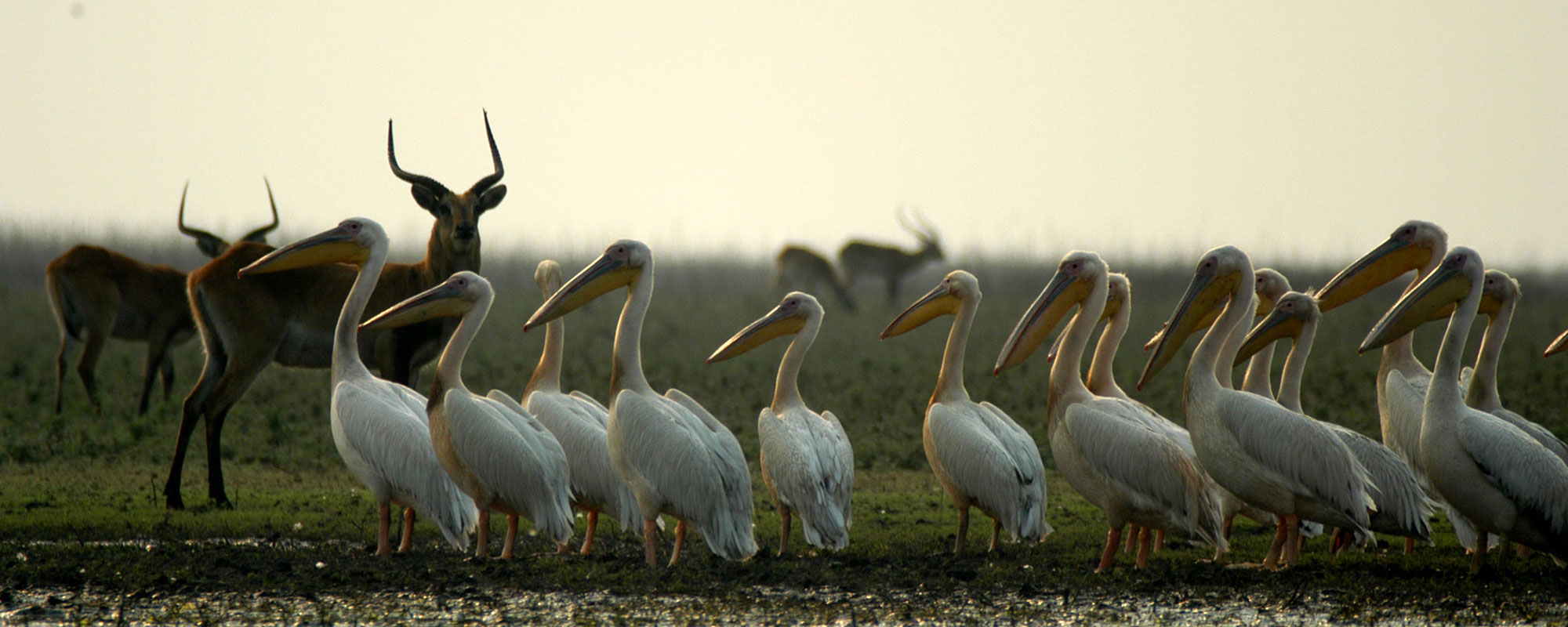
Lochinvar, although not abundant in the larger mammals, is nonetheless a park of exceptional beauty and outstanding birding opportunities with over 420 recorded species in its 428 square kilometers.

The Park is situated on the southern edge of the Kafue Flats, a wide floodplain of the Kafue River between Itezhi tezhi dam in the west and Kafue Gorge in the east. The area extends for 33kms from the Kafue River in the north to low wooded hills in the south. It includes the large, shallow Chunga Lagoon which fluctuates considerably in size with variations in river levels. The varying vegetation makes it an interesting park to visit with floodplains, woodlands and termitaria

It is particularly well known for the large herds of Kafue lechwe, unique to the Kafue flats. Other antelope are the blue wildebeest, kudu, oribi and buffalo. Waterbirds are especially abundant.

The Kafue Flats floodplain, in the northern section, floods from the Kafue River, and here you’ll find thousands upon thousands of the endemic Kafue lechwe, one of three subspecies of lechwe found in Zambia. More than 30 000 of them make the flats their home and move seasonally according to the flood level.

At high water, massive herds may be seen along the upper floodline and in the open grassland further south. As the floods recede the herds move north into the grassy floodplain. They feed on grasses and herbs in water up to a meter deep and are often seen wading or swimming in the Chunga Lagoon. Mating takes place mainly between December and January. Males fight over small territories known as leks and then mate with several females.

Izebra.tif (127635 bytes)n the Termitaria Zone, trees and shrubs grow only on the large termite mounds with grasses and herbs covering the rest of the area, which often becomes waterlogged during the rainy season. There are also many small grey mounds which are always unvegetated. The magpie shrike is one of the birds to be seen in the scattered trees of this zone and the surrounding grassy plains are grazed by buffalo, zebra, wildebeest and oribi. Very much in evidence is the ‘candelabra’ tree.

The southern area is mainly woodland dominated by Acacia albida and Combretum trees and free from flooding. Bushbuck kudu, baboon, bushpig and vervet monkey inhabit this area.

The Gwisho Hot Springs occur along a geological fault here, surrounded by lush vegetation and vegetable ivory palms. The water rises by convection from depths of over 1 km with temperatures ranging from 60° to 90° C. There are high concentrations of sodium, chlorine, calcium and sulphates in the water. A distinctive rock known as a ‘fault breccia’ occurs along the line of the fault and can be seen at Gwisho or the Lodge.

Sebanzi Hill is an archaeological site which has been excavated. It was the site of an iron age village, inhabited for most of the last century. Look out for The Baobab Tree with a hollow trunk large enough for several people to sleep in. Historically the tree was said to boast special powers which would protect passing travellers from wild animals. There is a curious rocky outcrop called Drum Rocks not far from the lodge, which produces a resonant sound when tapped. They are also part of local superstition in former times and passers-by had to stop and greet the rocks before proceeding.

    Birdlife

bird watching.jpg (15473 bytes)There are no dangerous animals in the park, apart from buffalo and visitors are encouraged to walk about. Cars however should not leave the roads. Lochinvar is well renowned as a superb bird sanctuary featuring many different waterfowl, raptors, woodland species and migrants. 428 species have been recorded.

The floodplain is a wide almost flat area, with black clay soils, sloping almost imperceptibly towards the Kafue River. Vegetation is made up of grasses, sedges and herbs adapted to an annual pattern of flooding. Many plants grow up with the rising waters to become emerging aquatics at high flood. A few isolated winterthorns Acacia albida and palms Borassus aethiopum occur on the river banks. Hundreds of wattled cranes can be seen feeding on vegetable matter dug from the soft mud and the large marabou stork scavenging for stranded fish. Around Chunga Lagoon you’ll find the greater and lesser flamingo, the pink backed and white pelicans, African skimmer, Caspian tern, Baillon’s crake and the red knobbed coot. Many species of duck are abundant in this environment; the black duck, fulvous duck, whistling duck, pintail, garganey, southern pochard, pygmy goose, yellow billed duck and the Cape and European shovellers. Waders include avocet, the Mongolian, Caspian and Pacific golden plovers, whimbrel, turnstone, sanderling, little stint, spotted redshank, black tailed and bar tailed godwits and six species of sandpiper. Over 50 raptors occur including the black sparrowhawk, osprey, secretary bird, African cuckoo hawk and the peregrine falcon to name a few. Other interesting sightings include the white-bellied and black bellied korhaans, yellow throated sandgrouse, narina trogon, and Denham’s bustard.

   Conservation

The IUCN and WWF have designated the Kafue Flats a wetland of international importance under the Ramsar Convention. A sponsored management project for the area attempts to give local people an interest in conservation through both redistribution of tourist revenue and controlled harvesting of resources. The fishermen you may come across in the park are very much a part of this unique ecosystem and in many ways the humans and wildlife here are interdependent.

    When to go

Anytime of the year is accessible although care is needed in the wet season after heavy rains. A 4WD is not necessary although advantageous in the rainy season as road conditions vary according to last rainfall and when the roads were last graded. Peak floods are reached in May at the end of the rainy season, while the water is at its lowest in October and November at the end of the dry season. The profusion of birds is extensive during the wet season when migrants arrive from the north. The game however is easier to spot in the dry season.

    Getting there

Lochinvar is only a three hour drive from Lusaka and is also accessible by charter aircraft. The access road is via the town of Monze on the Livingstone - Lusaka road. Monze is 282 kms from Livingstone and 186kms from Lusaka. Just north of the grain silos at Monze, turn west along a gravel road signposted at Namwala, then after about 25kms turn right at the signpost to Lochinvar, a distance of about 48 kms. The park gates are open between 6h00 and 18h00 and park fees are payable on entry.

   Where to stay

  • Lechwe Plains Tented Camp Your luxurious tent is near the water’s edge, enabling intimate views of some of the thousands of Lechwe and 428 bird species that inhabit the channels and islands. The day’s adventures could include a cultural visit to the nearby fishing village or a morning out questing for the rare sitatunga, an aquatic antelope of incredible grace. Later perhaps a ride in an authentic dugout canoe in search of a fish-eagle’s nesting site.
     

  • The World Wildlife Fund operate a campsite close to the southern gate. Simple chalets are also available here.


PACKAGE TOURS offers a list of tour operators that will arrange all your travel requirements to Lochinvar and other Zambian destinations.

Click on International Travel Agents if you're looking for an agent in Europe, US or Australia booking trips to Zambia and other Southern African countries.


Google

See the new page
VIDEOS OF ZAMBIA
with short clips on
safaris, wildlife,
Victoria Falls,
adventures and more

CLICK HERE
for
the Tourist Board
Video on Zambia


Photo Gallery Pages
by destination,


Download
Electronic Brochures

* Zambia Highlights

 * Tourism Investment
Opportunities in the
 Kafue National Park


Designed and hosted
by
 
for the
Zambia National

Tourist Board


Contact Webmaster                                Contact ZNTB  offices                         © All text on this site is under Copyright